What Is Chain of Custody in a DNA Test? Why It Matters for Immigration
Canada Immigration DNA Testing Series — Part 5
If a DNA laboratory can determine whether two people are biologically related, why does it matter who collected the samples?
Because for an immigration, citizenship, court or other official-purpose DNA test, there may be two separate questions:
1. What does the DNA show?
and
2. Whose DNA was actually tested?
This is where Chain of Custody becomes important.
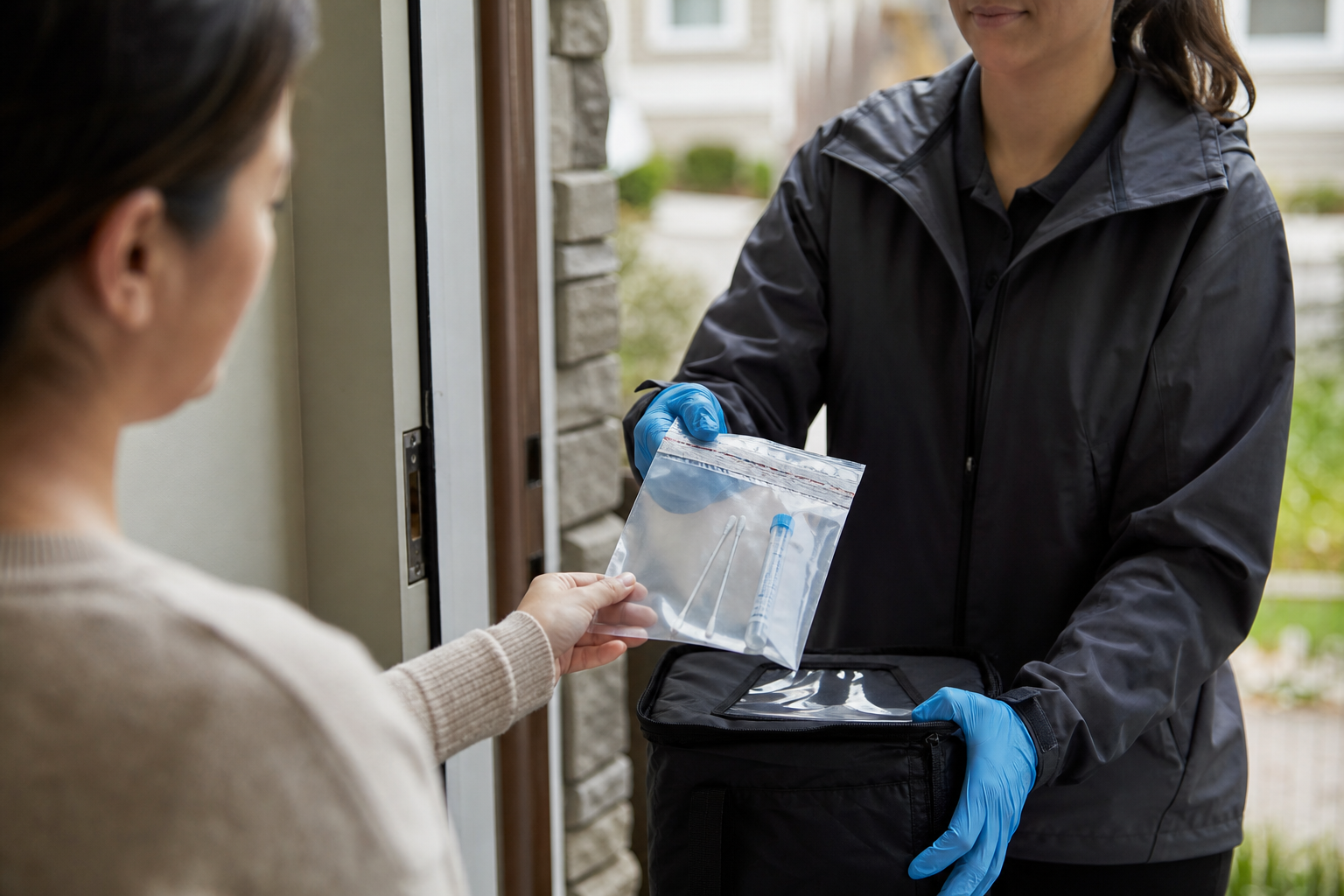
Chain of Custody is the documented process used to help establish the connection between the person being tested, the sample collected from that person and the sample ultimately analyzed by the laboratory.
In simple terms:
Identity → Collection → Sample → Transfer → Laboratory
For an official-purpose DNA test, the integrity of this process can be just as important as the laboratory analysis itself.
1. What Does “Chain of Custody” Mean?
In DNA testing, Chain of Custody generally refers to the documented handling of a DNA sample from collection through transfer to the laboratory.
Depending on the type of test and applicable requirements, the process may involve:
- verifying the participant's identity;
- recording identifying information;
- collecting the DNA sample;
- identifying and labelling the sample;
- documenting the collection;
- sealing the sample;
- recording the transfer of the sample; and
- delivering the sample to the laboratory under the required procedure.
The purpose is straightforward:
To create a traceable connection between the person identified in the case and the DNA sample analyzed by the laboratory.
2. Why Is Identity Verification Important?
Consider two different DNA tests.
Example A — Private Home DNA Test
A father orders a DNA kit online.
He collects his own cheek-swab sample and collects another sample from a child.
He places both samples in envelopes and mails them to a laboratory.
The laboratory receives two samples and analyzes them accurately.
The result may show an extremely strong biological relationship.
But the laboratory may not independently know:
Who actually provided those samples?
Example B — Controlled DNA Collection
The participant attends a collection appointment.
Depending on the applicable procedure:
- identification may be checked;
- the participant's information may be recorded;
- the sample is collected under controlled conditions;
- the sample is labelled;
- documentation is completed;
- the sample is sealed; and
- its transfer to the laboratory is documented.
Now there is a documented connection between:
the identified person
and
the sample analyzed by the laboratory.
That is the practical value of Chain of Custody.
3. Chain of Custody Does Not Make the DNA “More Accurate”
This is an important distinction.
A professionally collected DNA sample does not automatically contain “better DNA” than a properly collected home sample.
The laboratory science may be similar.
The difference is primarily about:
identity and traceability.
A private DNA test may accurately answer:
“Are Sample A and Sample B biologically related?”
A properly documented official-purpose process may also help establish:
“Sample A came from this identified person, and Sample B came from that identified person.”
Therefore:
DNA accuracy and sample identity are two different issues.
4. What May Happen During a Chain-of-Custody DNA Collection?
The exact procedure varies according to the laboratory, receiving authority and purpose of the test.
A typical controlled collection may include several steps.
Step 1 — Identity Verification
Participants may be asked to present government-issued identification.
For example:
- passport;
- national identity card; or
- other acceptable identification.
For children, additional documents or guardian involvement may be required.
Step 2 — Participant Information
Relevant identifying information may be recorded as part of the collection documentation.
Step 3 — DNA Sample Collection
DNA is commonly collected using a buccal or cheek swab, depending on the test and laboratory procedure.
Step 4 — Sample Identification
The sample is associated with the participant and appropriately labelled.
Step 5 — Documentation
The collection process is documented according to the applicable procedure.
Step 6 — Sample Sealing and Transfer
The collected sample may be sealed and transferred according to the required process.
Step 7 — Laboratory Receipt and Testing
The laboratory receives the sample, performs the DNA analysis and prepares the applicable report.
The basic idea is:
Person → Verified Identity → Collected Sample → Documented Transfer → Laboratory
5. Why Can Self-Collection Be a Problem for Official Purposes?
Imagine someone submits a home DNA sample labelled:
“John Smith — Father.”
The laboratory can test the sample.
But unless the collection process independently established the donor's identity, the label itself does not prove that John Smith actually provided it.
This is why a perfectly accurate laboratory analysis may still be unsuitable for a particular official purpose.
The issue is not necessarily:
“Is the laboratory result scientifically correct?”
The issue may instead be:
“Can the receiving authority rely on the identity attached to the sample?”
6. Does Every IRCC DNA Test Require the Same Chain-of-Custody Procedure?
No.
Applicants should not assume that every immigration or citizenship DNA case follows one universal procedure.
Requirements may depend on:
- the type of application;
- the reason DNA testing has been requested;
- the instructions issued in the particular case;
- laboratory requirements; and
- where the participants are located.
For some citizenship parentage cases, IRCC states that it may request DNA testing and provide a list of accredited laboratories.
Therefore, if IRCC has specifically requested DNA testing:
Read the instructions first and arrange collection second.
Do not independently choose a procedure simply because it is advertised online as an “Immigration DNA Test.”
7. Is a Chain-of-Custody DNA Test Automatically “IRCC Approved”?
No.
This distinction is important.
A DNA test may use professional collection and Chain-of-Custody procedures.
That does not, by itself, mean the test should automatically be described as:
“IRCC approved.”
The applicable requirements of the particular immigration or citizenship case still need to be confirmed.
Similarly, terms such as:
Legal DNA Test
Court-Admissible DNA Test
Chain-of-Custody DNA Test
and
Immigration DNA Test
should not be treated as interchangeable without checking the intended use and applicable requirements.
8. What If Family Members Are in Different Countries?
Chain of Custody can become particularly important when participants are located in different countries.
For example:
Father — Vancouver, Canada
Child — Shanghai, China
The participants may not need to be physically together.
Instead, appropriate sample collection may be coordinated separately, depending on the requirements applicable to the case.
Each participant's identity and sample may need to be handled according to the required procedure before the samples are analyzed.
For a detailed explanation of international collection, see:
Part 4 — Parent in Canada, Child in China: How Does International Immigration DNA Testing Work?
9. What Should You Do If You Receive an IRCC DNA Request?
Before collecting any sample, answer these questions:
1. What exactly does the IRCC correspondence ask you to do?
2. Who needs to participate in the DNA test?
3. Where is each participant located?
4. Are there laboratory requirements in the instructions?
5. What identity-verification and sample-collection procedure applies?
Only after these questions are clear should the collection process begin.
The safest sequence is:
Request → Requirements → Laboratory/Collection Arrangement → Identity Verification → Sample Collection → Testing
10. DNA Sample Collection and Chain-of-Custody Coordination
KINORA DNA assists with DNA testing coordination and professional sample-collection arrangements in Canada and internationally.
KINORA DNA services include:
- DNA relationship testing coordination
- Professional DNA sample collection in Canada
- Identity-verification support
- Chain-of-custody sample-collection coordination
- Immigration DNA testing coordination
- International DNA sample-collection arrangements
- Paternity and maternity DNA testing coordination
- Parent-child and other family relationship DNA testing
If you have already received an IRCC DNA testing request, prepare the following information before arranging collection:
Purpose of test: IRCC, citizenship, court, another government authority or private use
Participants: Who needs to provide DNA samples?
Locations: Country and city of each participant
Official correspondence: Any DNA testing instructions received from IRCC or another authority
KINORA DNA
DNA Testing and Professional Sample Collection Coordination
Website: kinoradna.com
Email: hello@kinoradna.com
Canadian and international DNA sample-collection arrangements are available for consultation.
Important: For IRCC or other government purposes, applicable laboratory, identity-verification, Chain-of-Custody and sample-collection requirements should be confirmed before DNA samples are collected.
Frequently Asked Questions
What is Chain of Custody in a DNA test?
It is the documented process that helps connect an identified participant with the DNA sample collected from that person and tracks the sample through the required collection and transfer process.
Is Chain of Custody the same as DNA testing?
No.
DNA testing analyzes biological information.
Chain of Custody concerns the identity, collection and handling of the sample.
Is a home DNA test less accurate?
Not necessarily.
The laboratory analysis may still be accurate. The issue for an official purpose may be whether the identity of the person providing the sample was independently established.
Can I collect my own sample for an immigration DNA test?
Do not assume self-collection will satisfy the requirements of an immigration or other official-purpose test. Check the instructions applicable to the case before collecting samples.
Does professional DNA collection automatically make a test acceptable to IRCC?
No.
Professional collection and Chain of Custody may be important parts of the process, but the applicable laboratory and testing requirements still need to be confirmed.
Can Chain-of-Custody collection be coordinated internationally?
Depending on the test requirements and locations involved, sample collection may be coordinated for participants in different countries.
The Key Point
Chain of Custody does not answer:
“Are these people biologically related?”
The DNA analysis answers that question.
Chain of Custody helps answer another important question:
“Can we establish whose samples were actually tested?”
For private information, this distinction may not always matter.
For immigration, citizenship, court or other official purposes, it can be critical.
That is why the correct order is:
Determine the purpose → Confirm the requirements → Verify identity → Collect samples → Test the DNA
Canada Immigration DNA Testing Series
Part 1 — Immigration DNA Testing in Canada: When Can IRCC Request a DNA Test?
Part 2 — Received an IRCC DNA Test Request? Complete Guide to the Process, Laboratory, Sample Collection and Important Considerations
Part 3 — Immigration DNA Test vs. Regular Paternity Test: What’s the Difference?
Part 4 — Parent in Canada, Child in China: How Does International Immigration DNA Testing Work?
Part 5 — What Is Chain of Custody in a DNA Test? Why It Matters for Immigration — You are here
Coming next:
Part 6 — Missing Birth Certificate or Conflicting Family Records: Will IRCC Require DNA Testing?
This article is provided by CAN-MIGRATE for general informational purposes only and does not constitute legal or immigration advice. Immigration and citizenship requirements may change. Applicants should follow current IRCC requirements and any instructions issued specifically for their application.
DNA检测中的Chain of Custody是什么?为什么移民亲子鉴定需要身份核验?
加拿大移民 DNA 检测系列——第5篇
既然实验室可以准确判断两个人有没有生物学亲属关系,为什么还要强调谁负责采样?
因为对于移民、公民身份、法院或者其他正式用途的 DNA 检测,实际上可能需要解决两个不同的问题:
第一,DNA检测结果是什么?
以及:
第二,实验室检测的DNA到底是谁的?
这就是 Chain of Custody 的意义。
简单来说,Chain of Custody 是通过记录身份核验、样本采集和样本交接过程,帮助建立:
被检测人 → DNA样本 → 实验室检测结果
之间的可追溯关系。
一、Chain of Custody到底是什么?
在 DNA 检测中,Chain of Custody 通常可以理解为从样本采集到交给实验室期间,对样本身份和处理过程进行记录。
根据检测用途和适用要求,可能包括:
- 核验被检测人的身份
- 记录身份信息
- 采集DNA样本
- 对样本进行编号和标识
- 记录采样过程
- 密封样本
- 记录样本交接
- 按照相应程序送往实验室
目的非常简单:
让报告上的这个人,与实验室实际检测的DNA样本之间建立可以追溯的联系。
二、为什么身份核验这么重要?
我们比较两个场景。
场景A:普通Home DNA Test
父亲在网上购买一个 DNA 试剂盒。
自己采集口腔样本,再给孩子采集一份,然后一起寄给实验室。
实验室可以非常准确地检测两份 DNA 是否存在生物学亲属关系。
但是实验室未必能够独立确认:
这两份样本到底是谁提供的?
场景B:受控DNA采样
被检测人参加正式采样。
根据适用程序,可能进行:
- 身份证件核验
- 被检测人信息记录
- 专业采样
- 样本编号
- 采样文件记录
- 样本密封
- 样本交接记录
这样就能够在:
被核验身份的人
与
实验室收到的DNA样本
之间建立记录。
这就是 Chain of Custody 的实际价值。
三、Chain of Custody不会让DNA“更准确”
这是一个非常容易误解的问题。
专业采样并不会让一个人的 DNA 变得“更准确”。
如果 Home DNA Test 的样本本身没有问题,实验室同样可能准确分析。
真正的区别主要在于:
身份和可追溯性。
普通私人检测可能准确回答:
“样本A和样本B有没有生物学亲属关系?”
而正式程序还可能需要确认:
“样本A来自这个被核验身份的人,样本B来自另一个被核验身份的人。”
因此:
DNA检测准确性和样本身份确认,是两个不同的问题。
四、Chain-of-Custody采样可能包括什么?
具体程序会根据实验室、接收报告的机构以及检测用途而不同。
一般可能涉及以下步骤。
第一步:身份核验
被检测人可能需要出示政府签发的身份证件,例如:
- 护照
- 身份证
- 其他符合要求的身份证件
未成年人可能还涉及监护人和其他文件。
第二步:记录被检测人信息
按照相应采样程序记录身份和检测相关信息。
第三步:采集DNA样本
根据检测及实验室程序,DNA通常可以通过口腔拭子等方式采集。
第四步:样本标识
把采集到的样本与相应被检测人进行正确对应和标识。
第五步:完成采样记录
按照适用程序记录采样过程。
第六步:密封和交接样本
按照相应要求处理、密封和交接样本。
第七步:实验室检测
实验室收到样本后进行 DNA 分析并出具相应报告。
整个逻辑可以概括成:
本人 → 身份核验 → DNA采样 → 记录和交接 → 实验室
五、为什么自己在家采样可能不适合正式用途?
例如,有人寄给实验室一份 DNA 样本,上面写着:
“John Smith — Father”
实验室当然可以检测这份 DNA。
但如果没有独立身份核验和采样记录,仅仅在样本上写一个名字,并不能证明这份样本一定是 John Smith 本人提供的。
所以,即使实验室分析结果完全准确,也不代表这个检测程序一定适合某项正式用途。
问题不一定是:
“DNA检测准不准?”
而可能是:
“接收报告的机构能不能确认样本对应的身份?”
六、所有IRCC DNA检测的Chain of Custody要求都一样吗?
不是。
不要认为所有加拿大移民和公民身份 DNA 检测都存在一套完全相同的统一程序。
具体要求可能取决于:
- 申请类型
- 为什么要求DNA检测
- IRCC针对具体案件发出的通知
- 实验室要求
- 被检测人所在国家
因此,如果已经收到 IRCC DNA 检测通知:
先看通知要求,再安排检测和采样。
不要仅仅因为网上某项服务写着“Immigration DNA Test”,就直接购买并自行采样。
七、有Chain of Custody就是“IRCC Approved”吗?
不是。
这一点非常重要。
一项 DNA 检测即使进行了专业采样和 Chain of Custody,也不能仅仅因此就宣传为:
“IRCC Approved DNA Test”
仍然需要确认具体案件适用的实验室、检测以及报告要求。
同样:
Legal DNA Test
Court-Admissible DNA Test
Chain-of-Custody DNA Test
Immigration DNA Test
这些名称不能在没有确认具体用途和要求的情况下简单画等号。
八、家庭成员在不同国家怎么办?
如果家庭成员分别位于不同国家,Chain of Custody 的协调就更加重要。
例如:
父亲——加拿大温哥华
孩子——中国上海
双方不一定需要在同一个地点采样。
根据具体检测要求,可以进一步确认是否分别协调适当的身份核验和样本采集。
关于跨国采样,我们已经在本系列第4篇详细介绍:
第4篇:《父母在加拿大、孩子在中国:移民DNA跨国采样怎么做?》
九、收到IRCC DNA通知以后应该怎么做?
在正式采样之前,先确认几个问题:
1. IRCC通知具体要求做什么?
2. 哪些家庭成员需要参加检测?
3. 每个人目前在哪个国家和城市?
4. 通知中是否涉及实验室要求?
5. 应该按照什么身份核验和采样程序进行?
确认以后,再正式安排采样。
比较合理的顺序是:
收到通知 → 确认要求 → 安排实验室/采样 → 身份核验 → 采样 → DNA检测
十、DNA专业采样及Chain-of-Custody协调
KINORA DNA 提供加拿大及国际 DNA 检测协调和专业样本采集安排。
KINORA DNA服务包括:
- DNA亲属关系检测协调
- 加拿大专业DNA样本采集
- 身份核验支持
- Chain-of-Custody样本采集协调
- 移民DNA检测协调
- 国际DNA样本采集安排
- 父子/父女及母子/母女亲子鉴定协调
- 其他亲属关系DNA检测
如果已经收到 IRCC DNA 检测通知,咨询之前可以准备以下信息:
检测用途: IRCC、公民身份、法院、其他政府机构或者私人用途
参加检测人员: 哪些人需要提供DNA样本?
所在地: 每个人所在的国家和城市
正式通知: IRCC或其他机构发出的DNA检测相关要求
KINORA DNA
DNA检测及专业样本采集协调
网站:kinoradna.com
可咨询加拿大本地及国际 DNA 样本采集安排。
重要提示:用于IRCC或其他政府用途的DNA检测,应在采样之前确认适用的实验室、身份核验、Chain of Custody及样本采集要求。
常见问题FAQ
DNA检测中的Chain of Custody是什么意思?
它是通过记录身份核验、样本采集和样本交接过程,帮助建立被检测人与实验室实际检测样本之间联系的程序。
Chain of Custody就是DNA检测吗?
不是。
DNA检测负责分析生物学信息。
Chain of Custody主要涉及样本身份、采集和处理过程。
Home DNA Test是不是不准确?
不一定。
实验室分析仍然可能非常准确。正式用途关注的另一个问题是:提供样本的人的身份有没有得到适当确认。
移民DNA可以自己在家采样吗?
不要自行假设可以。应该首先查看具体案件适用的实验室、身份核验和样本采集要求。
专业采样以后就一定能被IRCC接受吗?
不一定。
专业采样和 Chain of Custody 可能是正式检测程序的重要组成部分,但仍然需要确认具体案件适用的实验室和检测要求。
不同国家可以分别做Chain-of-Custody采样吗?
根据检测要求以及参与人所在国家,可以进一步协调不同地点的样本采集安排。
最核心的一点
Chain of Custody 本身并不回答:
“这两个人有没有生物学亲属关系?”
这个问题由 DNA 分析来回答。
Chain of Custody 主要帮助解决另外一个问题:
“实验室检测的DNA到底是谁提供的?”
对于私人了解结果,这个区别可能没有那么重要。
但是对于移民、公民身份、法院或其他政府正式用途,它可能非常重要。
因此,更合理的顺序是:
确定用途 → 确认要求 → 核验身份 → 正式采样 → DNA检测
加拿大移民DNA检测系列
第1篇:《加拿大移民DNA检测指南:IRCC什么情况下会要求亲子鉴定?》
第2篇:《收到IRCC要求做DNA检测怎么办?完整流程、实验室、采样与注意事项》
第3篇:《加拿大移民DNA检测和普通亲子鉴定有什么区别?》
第4篇:《父母在加拿大、孩子在中国:移民DNA跨国采样怎么做?》
第5篇:《DNA检测中的Chain of Custody是什么?为什么移民亲子鉴定需要身份核验?》——本文
接下来:
第6篇:《出生证明丢失或亲属关系文件有问题,IRCC一定会要求DNA吗?》
本文由 CAN-MIGRATE 提供,仅供一般信息参考,不构成法律意见或移民法律意见。加拿大移民及公民身份要求可能发生变化,申请人应遵循 IRCC 最新规定以及针对本人申请发出的具体通知。